The Machines Are Not Replacing You, They Are Redefining Your Role
You have probably heard the warning more times than you can count. Machines are coming for your job. Automation is accelerating. Algorithms are smarter than ever. It sounds dramatic, almost cinematic. And yet, that framing misses what is actually happening on the ground. You are not being pushed out. You are being repositioned.
This shift is quieter, more subtle, and far more interesting than the fear headlines suggest.
Contents
Why the Fear Narrative Misses the Bigger Picture
Fear sells because it simplifies a complex reality into a single threat. But work has always evolved through tools. The spreadsheet did not eliminate accountants. Email did not erase communication roles. What changed was how humans spent their time and where their value concentrated.
Right now, machines are absorbing tasks that are repetitive, predictable, or rule-based. That does not remove human contribution. It strips away the parts of your work that never really needed your judgment in the first place. What remains is context, decision making, interpretation, ethics, and creativity.
The fear narrative assumes jobs are static objects. They are not. They are bundles of activities. When machines take over one layer, humans move up the stack. That pattern is consistent across every technological leap worth remembering.
How Collaboration Between Humans and Machines Actually Works Today
In practice, humans and machines already work together every day, even if you do not label it that way. Recommendation engines suggest options. Automation flags anomalies. Systems surface insights you would not have time to find manually.
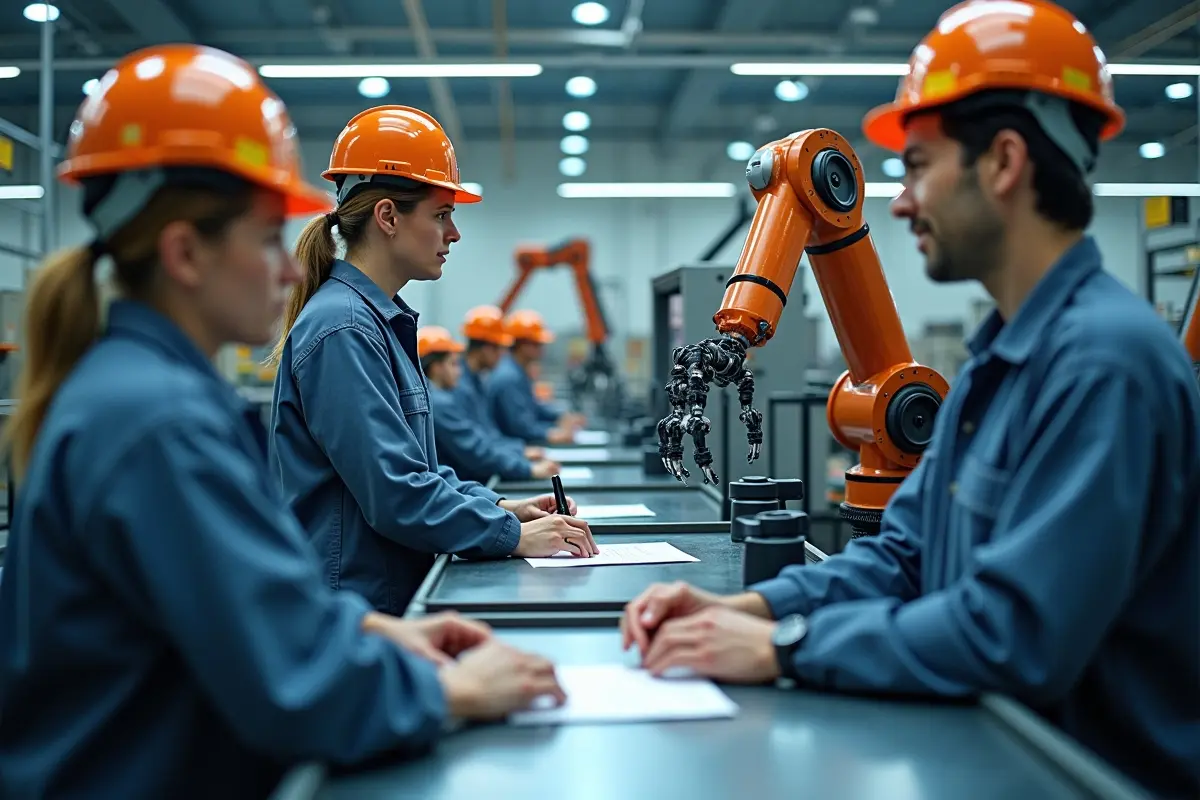
This is especially visible in environments where precision matters. In manufacturing, healthcare, logistics, and research, AI in robotics has shifted humans away from micromanaging movement and toward supervising outcomes. The machine executes. You interpret. You intervene when nuance matters. You decide what should happen next.
The collaboration works because machines are excellent at consistency and scale. Humans are excellent at meaning and adaptation. One without the other underperforms. Together, they create roles that did not exist ten years ago and will keep changing shape.
From Task Owner to System Thinker
One of the biggest shifts you may not have named yet is this: your value is moving from doing the task to understanding the system.
Instead of asking, “How do I perform the work faster?” the better question becomes, “How do I guide, audit, and improve how the work happens?” That requires curiosity. It requires comfort with ambiguity. It requires you to think in flows, not checklists.
This is not about becoming technical overnight. It is about becoming literate enough to collaborate with tools rather than compete with them.
Preparing Yourself for a Skills Shift That Is Already Happening
You do not prepare by panic-learning every new platform. You prepare by strengthening skills machines struggle with. Sense-making. Clear communication. Ethical judgment. Pattern recognition across messy information.
You also prepare by letting go of identity tied to a single task. When your role is defined by outcomes instead of procedures, adaptation becomes easier. You stop asking what the machine can do better than you and start asking what it needs from you.
That is where leverage lives.
The Quiet Opportunity Inside the Disruption
The uncomfortable truth is that this transition rewards those who engage with it early. Not louder. Not faster. Just more honestly. If you treat machines as collaborators instead of competitors, you position yourself where decisions are made, not where buttons are pressed.
You are not being replaced. You are being asked to grow into a role that requires more judgment, not less. That is not a loss of relevance. It is an invitation to redefine it.